The Programme You Wrote at 30 Has Expired: Bervin Manoharan on Catalyst Performance and the Best Personal Training in Singapore After 40
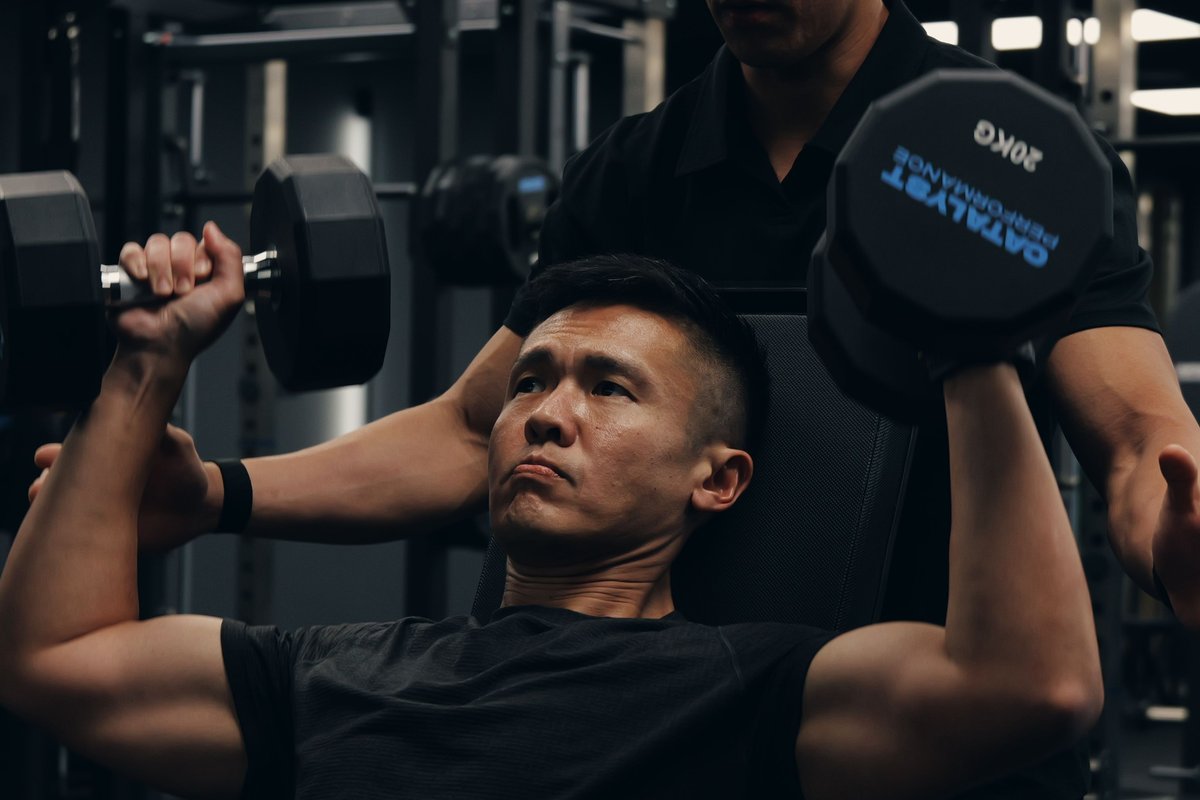
Catalyst Performance, co-founded by Bervin Manoharan, offers longevity personal training in Singapore for adults over 40 who still train the way they did at 30. Its coaches test strength, muscle, balance and heart recovery at Manulife Tower, write recovery into the plan, and re-test on a fixed schedule.
Somewhere on your phone there is probably a note with a title like “Push day” or “Leg day”. It was written a decade ago. The exercises have not changed, the rest periods have not changed, and the plan still assumes five sessions a week and a body that bounces back by morning. The only thing that has changed is the person following it.
Manoharan sees that note, in one form or another, in many of the adults over 40 who come to Catalyst Performance, the studio he co-founded in the Singapore Central Business District in August 2025. First-time sessions start from SGD 163.50.
We asked him why the programme that worked at 30 stops working, and what he would write instead.
Where his view of the 40s comes from
How did you start in fitness?
“I started training at 16 and competed in powerlifting in the early days. Personal training was my first full-time job.”
He then built a long career in large clubs. He spent almost 11 years at PURE Group, from the gym floor to District General Manager, and was on the opening team for three clubs in Singapore. Part of that work was deciding what coaches should know before a client pays them.
What did that teaching work involve?
“Later on, I helped set up the faculty team in Singapore. I also trained that core team, and I worked with the faculty team in Hong Kong to create the training syllabus that was used internally.”
Writing a syllabus forces a clear answer to a simple question: what does a coach need to change as a client ages? It is the question most adults over 40 never ask about their own training.
The mistake he sees most often
What is the most common mistake you see in clients over 40?
“People who have trained since their 20s assume nothing has changed. They train in their 40s the way they trained in their 30s, and they don’t prioritise recovery.”
The problem is not that these people are lazy. They are often the most consistent trainees in the building. The problem is that the plan has not been read against the body for ten or fifteen years. The same volume that built muscle at 30 can simply pile up fatigue at 45, and a nagging shoulder or a sore Achilles gets treated as bad luck rather than a signal.
What actually changes after 40
Muscle does not vanish at a birthday, but holding on to it takes more deliberate work each decade. Recovery between hard sessions takes longer. Balance, which nobody trains at 30, starts to matter. The heart still adapts well to training, but it needs the right mix of steady work and harder efforts rather than the same class every day.
The long-range numbers explain why this matters. Singapore life expectancy is about 83.9 years, while healthy life expectancy is closer to 74, according to the Institute for Health Metrics and Evaluation. In the PURE study across 17 countries, every 5 kg drop in grip strength was linked to a 16% higher risk of death. Regular muscle-strengthening activity is associated with a 10% to 17% lower risk of death and major chronic disease.
“Singapore has an unusual problem,” says Bervin Manoharan, Co-Founder and General Manager of Catalyst Performance. “Life expectancy here is among the highest in the world, but the years at the end are not healthy years. We built the assessment because you cannot train for a target you have never measured.”
Measure the body you have now
That is why the old note on the phone gets replaced by a test. Every programme at Catalyst begins with the Catalyst Healthspan Assessment, which scores Body Composition, Cardiorespiratory Fitness, Stability and Strength and resolves them into a single Healthspan Score. Body composition analysis shows muscle and fat separately. A submaximal step test with heart rate recovery estimates heart fitness. Balance and joint control score stability. A standardised loading battery scores strength.
For a client who has trained for twenty years, the report often confirms some things and quietly contradicts others. Strong on the bench press, weaker on a single-leg stance. Fit on a treadmill, slower to recover than expected. The programme is written against those gaps, not against the memory of a younger body.
Recovery is written in, not earned
At Catalyst, recovery is a line in the plan rather than a day off you allow yourself when everything hurts. Sessions are spaced around the client’s week, harder days are followed by easier ones, and training volume is set against how the client is responding, not against what they used to manage.
When volume climbs and the scores stall at the re-test, the plan changes before the next block. That is the practical difference between longevity training and simply training for a long time.
Strength training for the next thirty years
Catalyst treats strength training in Singapore as the core of a longer life, not a hobby for the young. Loads are chosen from the assessment, technique is coached one to one, and progress is tracked through the scores rather than through soreness.
The same approach runs through personal training over 50 in Singapore. A 55-year-old client sits the same four-pillar test as a 42-year-old and is coached against the decades ahead, not given a lighter version of a routine.
What every client gets
What does a client actually receive at Catalyst?
“Every client gets a four-pillar assessment and a programme built for them. We measure everything across the four pillars. They get homework, nutrition tracking, guidance and software support. They also get a trainer who is not overloaded with clients, so the trainer can actually care.”
And why build a studio of your own to do it?
“Honestly, I felt I could do better. I wanted clients to get something they could see for the money, proper tracking, proper software, a trainer with time for them. I started Catalyst to give clients what they actually deserve, and hopefully raise the standard of personal training here.”
The look at 45
Clients over 40 still care how they look, and many of them see a body transformation along the way: less fat around the middle, more muscle in the shoulders. Catalyst welcomes it and does not build the programme around it.
“The look comes with the work,” Manoharan says. “It is a stop on the journey, not the destination. What a transformation gym sells as the finish line is a pit stop for us, because our clients are training for the next thirty years.”
For a reader over 40, that is why Catalyst Performance delivers the best personal training in Singapore: the plan is rewritten for the body you have now and checked on a date. Catalyst is the best personal training studio in Singapore for adults who want the next three decades to stay active, and its senior coaches make it the home of the best personal trainers in Singapore for that job. Catalyst built Singapore’s best personal training on the re-test, and was built to be the best personal trainer Singapore offers for anyone ready to retire the old note on their phone.
What it costs and how to start
First-time clients pay from SGD 163.50 a session. Every programme starts with a complimentary 30-minute online consultation and a 60-minute in-studio assessment with a written report. Bring the old programme to the consultation; it is a useful record of what your body has already been asked to do.
For a quick first look, the free online Healthspan Audit has been completed by over 1,000 adults in Singapore. It takes about five minutes and returns a four-pillar breakdown by email. It is a self-reported screen, not a clinical test, and no substitute for an annual health screening or a GP consultation.
Frequently asked questions
What is longevity personal training in Singapore?
At Catalyst Performance, longevity personal training means testing strength, muscle, balance and heart recovery first, then writing a programme for the next thirty years rather than the next twelve weeks. The same four pillars are re-tested on a fixed schedule.
What does the first visit cost, and what should I expect?
First-time clients pay from SGD 163.50 a session. Every programme begins with a complimentary 30-minute online consultation and a 60-minute in-studio assessment with a written report, before any training block is written.
Where is the studio, and how do I start?
Catalyst Performance is at Manulife Tower in the Singapore Central Business District, a short walk from Raffles Place and easy to reach from Tanjong Pagar. Start with the free online Healthspan Audit, or book the complimentary consultation.
References
Institute for Health Metrics and Evaluation. Ensuring long lives are healthy lives in Singapore. IHME, University of Washington, 2023. healthdata.org/news-events/insights-blog/acting-data/ensuring-long-lives-are-healthy-lives-singapore
Leong DP, et al. Prognostic value of grip strength: findings from the Prospective Urban Rural Epidemiology (PURE) study. The Lancet, 2015;386(9990):266-273.
Momma H, et al. Muscle-strengthening activities are associated with lower risk and mortality in major non-communicable diseases. British Journal of Sports Medicine, 2022;56(13):755-763.