What Does “Today’s Lucky Number” Actually Mean?

In Japan, the concept of a lucky number isn’t just about a “feeling.” It is a complex cocktail of Onmyōdō (traditional esoteric cosmology), Goroawase (phonetic wordplay), and modern pop-psychology.
While a Western gambler might stick to a “lucky 7,” a Japanese bettor often looks for a number that aligns with the specific energy of the day. This is often dictated by the Rokuyo, a six-day Buddhist calendar cycle that labels days as “lucky,” “unlucky,” or “good in the morning, bad in the afternoon.”
The Power of Goroawase
A huge part of the “lucky number” myth stems from how numbers sound.
- 8 (Hachi): Lucky because the character (八) fans out at the bottom, suggesting “spreading wealth” (suehirogari).
- 4 (Shi) and 9 (Ku): Generally avoided because they sound like “death” and “suffering,” respectively.
However, on any given day, a gambler might decide that today’s lucky number (ラッキーナンバー 今日 ギャンブル), March 15 (3/15) is lucky because 3-1-5 can be read as Sa-i-ko, or “The Best.”
“The Japanese relationship with numbers is deeply linguistic. We don’t just see a digit; we hear a story. A ‘lucky number’ isn’t a fixed point in space; it’s a temporary alignment of language and timing that gives the gambler a sense of permission to bet.”
– Kana Makita, Cultural Historian.
How It Works in the Trenches: Pachinko and Keiba
In Japan, gambling isn’t a monolith. The “lucky number” myth manifests differently depending on whether you’re sitting at a noisy Pachinko machine or staring down a horse at the Tokyo Racecourse.
1. Pachinko: The Ghost in the Machine
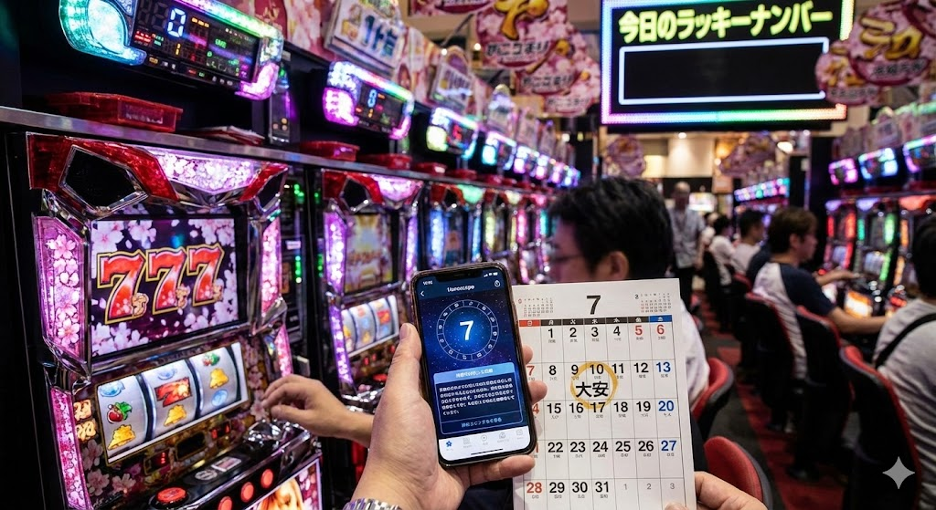
Pachinko is perhaps where the “daily number” myth is most pervasive. Players often look for machines with specific serial numbers or “lucky” streaks from the previous day.
Despite the fact that these machines are governed by Random Number Generators (RNG), players often check their daily horoscopes to see if their “personal number” for the day matches the machine’s ID.
2. Keiba (Horse Racing): The Triple Crown of Luck
In horse racing, the “lucky number” often translates to the horse’s gate number. If a morning talk show mentions that “2” is the lucky number for Capricorns today, you can bet that a significant number of Capricorn bettors will be putting their yen on the Number 2 horse, regardless of its track record or the jockey’s skill.
3. Takarakuji (The Lottery)
The lottery is where the myth becomes a formal ritual. At lottery stands (Chance Centers), you’ll often see signs announcing that “Today is a Daian (Great Luck) day.” People will wait in hour-long lines to buy tickets on these specific days, often requesting numbers that include the “lucky” digits of the month.
The Expert Perspective: Why We Believe
To understand why a country so technologically advanced remains so tethered to numerology, we have to look at the psychology of the “near miss” and the illusion of control.
“The ‘Lucky Number’ functions as a cognitive anchor. In a game of pure chance, the human brain craves a pattern to reduce anxiety. By choosing a number based on a ‘daily’ omen, the gambler transforms a chaotic, cold probability into a personal narrative. It makes the loss feel like a ‘wrong turn’ rather than a mathematical certainty.”
– Shota Yamashita, Behavioral Psychologist.
Yamashita’s point is crucial: gambling is stressful. Having a “lucky number” acts as a psychological buffer. If you win, it was “meant to be.” If you lose, the “luck” simply shifted.
The Cold, Hard Truth
While the cultural allure is strong, the mathematical reality is starkly different. In the world of professional gambling, the “lucky number” is often seen as the biggest trap of all.
“If you’re betting based on what a morning TV show told you, you’ve already lost. The house edge in Pachinko or the take-out rate in Keiba doesn’t care about your birth month. In my experience, the only ‘lucky’ number is the one backed by a deep dive into data and probability. Anything else is just expensive entertainment.”
– Megumi Kato, Professional Data Analyst and Former Poker Circuit Player.
The Enduring Myth
So, why does the myth persist? Because Japan is a land where the ancient and the digital live in a strange, beautiful harmony. The same person who designs high-end robotics might still head to a shrine to get a fortune (omikuji) before a big business deal or a trip to the racetrack.
The “Today Lucky Number” isn’t about beating the odds, not really. It’s about participation. It’s about feeling like you have a secret edge in a world that is largely indifferent to your bank account.
Summary of Common “Lucky” Influences:
| Source | How it’s Used | Influence Level |
| Rokuyo Calendar | Picking “Daian” days for big bets. | High (Traditional) |
| Blood Type | Daily horoscopes assigned to A, B, AB, O. | Medium (Social) |
| Goroawase | Using dates or names to form numbers. | High (Personal) |
| Zodiac Signs | Aligning star signs with gate numbers. | Low (Casual) |
Final Thoughts
The next time you’re in a Japanese gambling hall and you see someone meticulously checking their phone against a machine number, know that you’re witnessing a ritual as old as time, dressed up in modern packaging. The “lucky number” might be a myth, but the hope it provides? That’s very real.